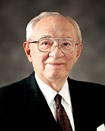
“Raise the Bar”
Brigham Young University–Idaho DevotionalJanuary 25, 2005 Elder Henry B. Eyring |
My beloved brothers and sisters, I am grateful to be with you again. I bring you the greetings of President Hinckley and the First Presidency, the Quorum of the Twelve, and especially Elder Bednar. You are loved and you are known and you are trusted.Each time I come here, I am struck by what seems to be continuous change. Many new buildings now stand where once we looked across open fields. What was a fine junior college is becoming a distinguished university. Thousands of students enroll who seem to be ever brighter and more spiritual. They study in classrooms, some of which I saw today, equipped with powerful teaching aids unknown just a few years ago. New faculty are choosing to join us who have remarkable professional preparation and great faith in the restored gospel. The rate of growth in physical structures will slow down, but spiritual and academic improvement will continue and will accelerate.
Change is also accelerating in the world around us. Some of that change, like that in this university, is for the better. But much of the acceleration in the world is in troubles long prophesied for the last days. Each time you watch the evening news, you see stark evidence of that. You remember this scripture: “For behold, at that day shall he [meaning Satan] rage in the hearts of the children of men, and stir them up to anger against that which is good” (2 Nephi 28:20). The Lord told us in the time of the Prophet Joseph that war would be poured out upon all nations. We see tragic fulfillment of that prophecy, bringing with it increased suffering to the innocent. The giant earthquake, and the tsunamis it sent crashing into the coasts around the Indian Ocean, is just the beginning and a part of what is to come, terrible as it was. You remember the words from the Doctrine and Covenants which now seems so accurate: And after your testimony cometh wrath and indignation upon the people. For after your testimony cometh the testimony of earthquakes, that shall cause groanings in the midst of her, and men shall fall upon the ground and shall not be able to stand. And also cometh the testimony of the voice of thunderings, and the voice of lightnings, and the voice of tempests, and the voice of the waves of the sea heaving themselves beyond their bounds. And all things shall be in commotion; and surely, men’s hearts shall fail them; for fear shall come upon all people (Doctrine and Covenants 88: 88-91). Fear shall come upon all people. But you and I know that the Lord has prepared places of safety to which He is eager to guide us. I think of that often. A few days ago, I heard two accounts of God leading His children to safety on the coast of Thailand when that monstrous tsunami wave struck. One was of people who accepted His apparently routine invitation to a Church meeting on a Sunday. The meeting was called by ordinary men who hold the priesthood of God. The meeting place was on higher ground, away from the coast. The people who gathered with the Saints were spared from physical death, while the places on the coast where they would have been were destroyed. As they were spared physical death, they were being strengthened against spiritual temptation and the wave of eternal tragedy it will bring to those who are disobedient. The other account I heard was related to me by a Latter-day Saint who was led to safety by the Holy Ghost. He checked into a hotel on the ocean front in Thailand the day before the wave struck. He walked out on the beach. He felt uneasy. He went back to his hotel determined to check out. The hotel staff, I think worried that he didn’t like the hotel, pressed him for a reason. They only reluctantly agreed to his leaving. He moved to another hotel, away from the beach. It was on higher ground. Because of that, he not only survived but stayed to serve the survivors. The Lord is anxious to lead us to the safety of higher ground, away from the path of physical and spiritual danger. His upward path will require us to climb. My mother used to say to me when I complained that things were hard, “If you are on the right path, it will always be uphill.” And as the world becomes darker and more dangerous, we must keep climbing. It will be our choice whether or not to move up or to stay where we are. But the Lord will invite and guide us upward by the direction of the Holy Ghost, which He sends to His leaders and to His people who will receive it. The mists of spiritual darkness will become more dense as we climb. They are described in the Book of Mormon this way: “And the mists of darkness are the temptations of the devil, which blindeth the eyes, and hardeneth the hearts of the children of men, and leadeth them away into broad roads, that they perish and are lost” (1 Nephi 12:17). But the word of God will guide those who develop the capacity to receive it through the ministrations of the Holy Ghost. A clear light piercing the darkness will show the way to those who have taken the Holy Ghost as a trusted and constant traveling companion. Now my purpose today is to share with you what I have learned over the years about getting and keeping the companionship of the Holy Ghost. It isn’t easy, but it is possible. The foundation is a burning desire to qualify for that gift. Most of us who are members of the restored Church have enough faith to want the Holy Ghost at times. That desire may be weak and intermittent, but it comes, usually when we are in trouble. For us to be led upward to safety in the times ahead, it must become steady and intense. The problem for most human beings is that when things go well, we feel self-sufficient. You remember the warning: “And others will he pacify, [again speaking of Satan] and lull them away into carnal security, that they will say: All is well in Zion; yea, Zion prospereth, all is well—and thus the devil cheateth their souls, and leadeth them away carefully down to hell” (2 Nephi 28:21). And later comes the warning: “Cursed is he that putteth his trust in man, or maketh flesh his arm, or shall hearken unto the precepts of men, save their precepts shall be given by the power of the Holy Ghost” (2 Nephi 28:31). If you examine your own experience carefully and honestly, you will see that you tend to seek the Holy Ghost most fervently when you are humbled by difficult circumstances or life-changing decisions. Remember the time you faced the prospect of teaching the gospel as a missionary perhaps in a new language where you couldn’t understand what people were saying and you couldn’t put a sentence together. Or, remember a time you had to make choices that might lead you toward, or away from, marrying someone. Those moments probably brought a great desire for the faith and the capacity to get the help of the Holy Ghost. But if we have to be in trouble to want the Holy Ghost as a constant companion, then to have that steady desire we will have to be in steady trouble. There has to be a better way. Happily, there is. Now you will have to find your own. I’ll tell you mine. There is one for me that works: I choose to remind myself about my experience with what prophets have said about the peace and happiness that comes with the visitation of the Holy Ghost. It has been true in my life. Wilford Woodruff described it this way: You may surround any man or woman with all the wealth and glory that the imagination of man can grasp, and are they satisfied? No. There is still an aching void. On the other hand, show me a beggar upon the streets, who has the Holy Ghost, whose mind is filled with that Spirit and power, and I will show you a person who has peace of mind, who possesses true riches, and those enjoyments that no man can obtain from any other source (Journal of Discourses, Vo. 2, p. 199, Wilford Woodruff, February 25, 1855). That has been true for me. One of the ways I know that I’m feeling the influence of the Holy Ghost is that I feel a light and I am happy. When the Holy Ghost seems far from me, I feel a darkness and I am not happy. I have felt that ebb and flow of light and happiness in my life and so have you. I like to feel of that light and I like to be happy. I don’t have to wait for troubles and tests to make me want the help of the Holy Ghost. I can choose to remember what that companionship has been like, and whenever I do, I want that blessing again with my whole heart. When we want the Holy Ghost and the peace of mind and enjoyment that comes with it, we know what to do. We plead with God for it in faith. It takes the prayer of faith to bring the companionship of the Holy Ghost. That faith has to be that God the Father, the Creator of all things, lives and wants us to have the Holy Ghost and wants to send us the Comforter. It takes faith that Jesus is the Christ and that He atoned for our sins and broke the bands of death. With that faith we approach our Father in reverence and with confidence that He will answer. With that faith we close our prayer in the name of Jesus Christ as His true disciples, confident that our deep repentance, our baptism by His servants, and our faithful service in His cause have purified us and made us clean and worthy of the blessing we seek, the companionship of the Holy Ghost. I have found myself setting a higher standard for my prayers for the Holy Ghost to guide me because of the great examples of others. A favorite for me is in 3 Nephi. Jesus had chosen disciples who would need the Holy Ghost as their companion when He was gone. Their example lifts me every time I read it and could lift you: “And they did pray for that which they most desired; and they desired that the Holy Ghost should be given unto them” (3 Nephi 19:9). It helps me to plead with more desire and faith when I read again the answer to their prayer: “The Holy Ghost did fall upon them, and they were filled with the Holy Ghost and with fire. And behold, they were encircled about as if it were by fire; and it came down from heaven, and the multitude did witness it, and did bear record” (3 Nephi 19:13-14). My prayers to receive the help of the Holy Ghost have been strengthened by pondering the record of the scriptures. And so has been my ability to recognize the message which the Holy Ghost brings. The scriptures tell us why that is so. The scripture declares: Angels speak by the power of the Holy Ghost; wherefore, they speak the words of Christ. Wherefore, I said unto you, feast upon the words of Christ; for behold, the words of Christ will tell you all things what ye should do. Wherefore, now after I have spoken these words, if ye cannot understand them it will be because ye ask not, neither do ye knock; wherefore, ye are not brought into the light, but must perish in the dark. For behold, again I say unto you that if ye will enter in by the way, and receive the Holy Ghost, it will show unto you all things what ye should do (2 Nephi 32: 3-5). I have found that is true: the words of inspiration from the Holy Ghost are words the Savior used. When I read the words spoken by the Savior in the scriptures, I grow in my capacity to recognize inspiration from the Holy Ghost. For that reason my personal scriptures tend to wear out unevenly. I go most often to those places in the Book of Mormon, in the Doctrine and Covenants, and in the Bible where the Lord is speaking. By doing that I can better recognize the voice of the Spirit when the Savior’s words echo easily in my mind. Just as pondering the scriptures invites the companionship of the Holy Ghost, so does doing the things we have been told to do and doing them promptly. We are promised that the scriptures and the Holy Ghost will tell us all things that we should do. When we go and do what we have been told and do it the best we can, we qualify for more instructions of what to do. If we do not act, we will not receive further instructions. My hero in this is the prophet Nephi, described in the book of Helaman. He is my example for “Go and do.” And behold, now it came to pass that when the Lord had spoken these words unto Nephi, he did stop and did not go unto his own house, but did return unto the multitudes who were scattered about upon the face of the land, and began to declare unto them the word of the Lord which had been spoken unto him, concerning their destruction if they did not repent (Helaman 10:12). His immediate obedience brought him the companionship of the Holy Ghost, just as it will for you and me. Here is the account: The power of God was with him, and they could not take him to cast him into prison, for he was taken by the Spirit and conveyed away out of the midst of them. And it came to pass that thus he did go forth in the Spirit, from multitude to multitude, declaring the word of God, even until he had declared it unto them all, or sent it forth among all the people (Helaman 10:16-17). Now, there is a wonderful way in which all the things about which we have spoken work together. Desire for the Holy Ghost leads us to the prayer of faith. Pondering the words of the Savior in the scriptures increases our capacity to recognize the voice of the Spirit. The Spirit and the words of Christ tell us all things that we must do. And as we do those things, we qualify for further inspiration by the Spirit. And, in time, that companionship of the Holy Ghost changes us. We feel the effects of the Atonement. Our desire for light increases, and so we pray with greater faith that our prayers will be answered. The scriptures open up to us more clearly, our power to obey becomes greater, and we are drawn ever upward, higher and higher, toward purity and happiness and eternal safety (see 3 Nephi 27:20; Alma 19:33; 3 Nephi 9:20). Now, all this has some practical applications for each of us. One is that we can repent and be cleansed to qualify for the gift of the Holy Ghost. That makes us optimists. We can be forgiven and be worthy to receive the Holy Ghost. With that gift, things will work out. The Holy Ghost has a sanctifying influence. So, people can improve. Tomorrow will be better. We can have rising expectations. You can set the bar for yourself a little higher and then a little higher, again and again. For instance, you returned missionaries can set your goal not to maintain the spirituality you felt in the mission field, but to rise higher. That will take work and determination but you can do it. Other people did some of your work for you, which you must now do for yourself. For instance, the Church set the bar higher for the standard to become a full-time missionary. Your mission president urged and lifted you to higher standards. Now, it is your responsibility to set the bar higher for yourself, not once, but again and again. That is true for all of us, not just for those who have been missionaries. The faculty of this university face the daunting reality that here there will be perpetual education innovation. What we have gone through was not only a transition from two to four years. It was a transformation into another kind of university, where education will be constantly getting better. I’ve taught in such a place. In my ten years on the faculty at Stanford, I was blessed never to teach the same course twice. I moved from field to field and changed every course I taught, every time. I remember the nights when I was still working when the dawn came. I remember the adrenaline pumping when I stood to face students with material as new to me as it was to them. I know that I got help from the Holy Ghost. If that help came to me there, it will surely come in greater power here. So, while I appreciate the challenge the faculty and staff face in this university, I await the future with happy anticipation. As the challenges around us increase, we must commit to do more to qualify for the companionship of the Holy Ghost. Casual prayer won’t be enough. Reading a few verses of the scripture won’t be enough. Doing the minimum of what the Lord asks of us won’t be enough. Hoping that we will have the Atonement work in our lives and that we will perhaps sometimes feel the influence of the Holy Ghost won’t be enough. And one great burst of effort won’t be enough. Only a steady, ever-increasing effort will allow the Lord to take us to higher ground. I know what some of you are tempted to think: “I’ll have to be careful not to set the bar for myself too high. I wouldn’t want to fail and be disappointed.” I did a little high-jumping over a bar in high school and in college. I know what it is like to be running toward the bar and see that it is higher than when you jumped last and that you are now looking way up at the bar. Some of you have been high-jumpers so that you know that it is very different when you come toward it so that you can look over it. I know what happens when you look up at that bar. You think, “That bar is over my head. Is it physically possible to put my whole body over a bar above my head?” As I look back, remember I was a physics student, I realized that I must have decided that some law of physics limited me. Well, the laws of physics did apply, but the limits were more in my mind than in reality. When I now see junior high school students, some of them girls, jumping higher than my best, I wish that I were young again. I’d set my expectations higher. More was possible than I thought, and more is possible spiritually for you and for me. And more is necessary. Set the bar a little higher for yourself. And then set it a little higher. In spiritual things you have a heavenly power lifting you beyond where you are now. The Lord promises that unending rise in his own voice in the Doctrine and Covenants: “That which is of God is light; and he that receiveth light, and continueth in God, receiveth more light; and that light groweth brighter and brighter until the perfect day” (Doctrine and Covenants 50:24). You can set the bar higher for yourself to get more power of faith to pray for the gift of the Holy Ghost. You can set it higher for yourself to have the scriptures opened so that you will come to know the Savior’s voice. You can set it higher for yourself to be obedient in the things He asks of you. And you can set the bar higher in your expectation for peace in this life and your hope, even your assurance of eternal life in the world to come. You can set your expectations for yourself a little higher and then a little higher, with confidence that a loving Heavenly Father and His Beloved Son will send you the Holy Ghost and lift you higher and higher, toward Them. I testify that God the Father lives and hears our prayers. He loves us. He loves His Son, our Savior, and He loves those who love and serve His Son. The Holy Ghost is real and constant in His service. I testify that the keys which unlock the gift of the Holy Ghost were restored through the Prophet Joseph and are now exercised by President Gordon B. Hinckley. When the Lord’s authorized servants say the words, “Receive the Holy Ghost,” I know that God honors that promise, as we honor our covenants with Him. Now as I leave you I would like to tell you something personal about you. I have been away from here a long time. If you had told me that an institution and students and the faculty could rise as high as they have risen spiritually in so short a time, I would have said, “It is not possible.” Just as I used to wonder if I could possibly keep going higher and higher jumping over a striped bar in a track field. I can’t imagine where this University will be in just a little while. I pray with all my heart that you know that I gave this message to you with a feeling of optimism, not of pessimism. I did not plan to speak to you about the hard times that are ahead and they are real, and they are coming. But as I prepared to come here I was given a feeling of light and confidence about you, that somehow the people I would be speaking to today were special, brought here and chosen because of your capacity to rise higher than you yourself would think even possible spiritually. As I was preparing to come, I was awakened, I will even tell you the time of day, at 1:00 in the morning. I had slept for only two or three hours and I think the Holy Ghost did it by telling me, “You’re rested,” which didn’t seem reasonable at that hour. “It is time to go.” So, I got up. In a period of five hours, when I planned to talk about quite a different thing, I wrote what I have given you. I was surprised. I thought that this isn’t the kind of thing you talk to young people about. You should tell more stories, or tell them something amusing, or try to catch their attention. But know you are special. Heavenly Father is inviting you upward, and you can move there if you have the determination and the grit to say to yourself, “I don’t have to be forced by circumstances to seek the Holy Ghost.” There will be some private things that you need to repent of. There will be some things you need to begin to do that you haven’t been doing. The Holy Ghost will tell you what those are and tell you all things that you must do. And I have every confidence you will not be overwhelmed, that Heavenly Father and the Savior will lift you up, and the Holy Ghost will be your companion in a more constant and powerful way. There is a God. He is our Father. He really knows us. He knows the future. I don’t know how He knows it in such detail, but He knows the future. He knows every challenge ahead of you. He knows every opportunity ahead of you. He knows your power and wants to lift you to every opportunity and to be able to go through every trial that may be ahead of you, and to go through, smiling. You will hear President Hinckley say, “I’m an optimist.” That is not just in his personality, that’s a fruit of having the Holy Ghost as a companion. I testify to you that the Holy Ghost can speak to your heart and your mind. And you can train yourselves to know that voice in such a way that you might move away from the beach as that man did in Thailand, or might be impressed to go to a sacrament meeting when you are on vacation, as people did in Thailand. They could have easily said, “Well, we are on vacation.” But no, they went to where the Lord wanted them to go. You will be the ones who will be able to hear the voice of the Spirit, and it will bless you in the times ahead. In the name of Jesus Christ, Amen. |

Outline - Learner Readiness
- Read the name of the lesson (Your Matter to Him) and the theme (The Lord uses a scale very different from the world's to weight the worth of a soul).
- Q: When I read this, does it give you positive, warm feeling or a cynical feeling (like, I don't matter Him or God doesn't watch over me, I take care of myself)?
- There are three section to President Uchdorf's talk:
- We are less than we suppose
- We are greater than we suppose
- The last shall be first
- Let's discuss what is mean to be less than we suppose. When Moses was give a vision of the workmanship of God's hands, he declared, I know that man is nothing.
- Let's read from P. Uchdorf's talk. Who has 'A'
A - Astronomers have attempted to count the number of stars in the universe. One group of scientists estimates that the number of stars within range of our telescopes is 10 times greater than all the grains of sand on the world’s beaches and deserts.
This conclusion has a striking similarity to the declaration of the ancient prophet Enoch: “Were it possible that man could number the particles of the earth, yea, millions of earths like this, it would not be a beginning to the number of thy creations.”5
Given the vastness of God’s creations, it’s no wonder the great King Benjamin counseled his people to “always retain in remembrance, the greatness of God, and your own nothingness.”
Q: In what context are we less than we suppose?
Say: Let's move to the next section of President Uchdorf's talk, "We Are Greater than we Suppose"
Who had Reading Selection B?
B - But even though man is nothing, it fills me with wonder and awe to think that “the worth of souls is great in the sight of God.”7
And while we may look at the vast expanse of the universe and say, “What is man in comparison to the glory of creation?” God Himself said we are the reason He created the universe! His work and glory—the purpose for this magnificent universe—is to save and exalt mankind.8 In other words, the vast expanse of eternity, the glories and mysteries of infinite space and time are all built for the benefit of ordinary mortals like you and me. Our Heavenly Father created the universe that we might reach our potential as His sons and daughters.
Let's read C
Let's read C
C - This is a paradox of man: compared to God, man is nothing; yet we are everything to God. While against the backdrop of infinite creation we may appear to be nothing, we have a spark of eternal fire burning within our breast. We have the incomprehensible promise of exaltation—worlds without end—within our grasp. And it is God’s great desire to help us reach it.
Learner Involvement starts here.
Learner Involvement starts here.
The Folly of Pride
READ - The great deceiver knows that one of his most effective tools in leading the children of God astray is to appeal to the extremes of the paradox of man.
Q: So, what are the two side of the paradox? (we believe we are not important to God or we believe that we are all important without God.)
Read E
Q: So, what are the two side of the paradox? (we believe we are not important to God or we believe that we are all important without God.)
Read E
E - Abraham Lincoln is said to have loved a poem that reads:
Oh why should the spirit of mortal be proud?
Like a swift-flitting meteor, a fast-flying cloud,
A flash of the lightning, a break of the wave,
Read F
F - Disciples of Jesus Christ understand that compared to eternity, our existence in this mortal sphere is only “a small moment” in space and time.10 They know that a person’s true value has little to do with what the world holds in high esteem. They know you could pile up the accumulated currency of the entire world and it could not buy a loaf of bread in the economy of heaven.
Question: How does wealth or security effect our estimation or ourselves?
Q: Should it?
[if there is opposition] Q: Why is it that we tie a man's earthly success to the amount of fame, education or money they possess?
Answer: Is it our American tradition, our Calvinist heritage?
F - Disciples of Jesus Christ understand that compared to eternity, our existence in this mortal sphere is only “a small moment” in space and time.10 They know that a person’s true value has little to do with what the world holds in high esteem. They know you could pile up the accumulated currency of the entire world and it could not buy a loaf of bread in the economy of heaven.
Question: How does wealth or security effect our estimation or ourselves?
Q: Should it?
[if there is opposition] Q: Why is it that we tie a man's earthly success to the amount of fame, education or money they possess?
Answer: Is it our American tradition, our Calvinist heritage?
READ G
G - Those who will “inherit the kingdom of God”11 are those who become “as a child, submissive, meek, humble, patient, full of love.”12 “For every one that exalteth himself shall be abased; and he that humbleth himself shall be exalted.”13 Such disciples understand also “that when ye are in the service of your fellow beings ye are only in the service of your God.”14
Q: How does the Lord measure a man?
Say, Let's more to the other side of the paradox.
G - Those who will “inherit the kingdom of God”11 are those who become “as a child, submissive, meek, humble, patient, full of love.”12 “For every one that exalteth himself shall be abased; and he that humbleth himself shall be exalted.”13 Such disciples understand also “that when ye are in the service of your fellow beings ye are only in the service of your God.”14
Q: How does the Lord measure a man?
Say, Let's more to the other side of the paradox.
We Are Not Forgotten
Read H
H- Another way Satan deceives is through discouragement. He attempts to focus our sight on our own insignificance until we begin to doubt that we have much worth. He tells us that we are too small for anyone to take notice, that we are forgotten—especially by God.
Say: Br U. tells a story about going to Big Spring, Texas for pilot training. He didn't know english very well and was in competition with the best of the best. In his spare time he worked on building the chapel with other ward members. He concludes the story by saying:
H- Another way Satan deceives is through discouragement. He attempts to focus our sight on our own insignificance until we begin to doubt that we have much worth. He tells us that we are too small for anyone to take notice, that we are forgotten—especially by God.
Say: Br U. tells a story about going to Big Spring, Texas for pilot training. He didn't know english very well and was in competition with the best of the best. In his spare time he worked on building the chapel with other ward members. He concludes the story by saying:
READ G
G - At the time, Big Spring, despite its name, was a small, insignificant, and unknown place. And I often felt exactly the same way about myself—insignificant, unknown, and quite alone. Even so, I never once wondered if the Lord had forgotten me or if He would ever be able to find me there.
READ H
H - I knew that it didn’t matter to Heavenly Father where I was, where I ranked with others in my pilot training class, or what my calling in the Church was. What mattered to Him was that I was doing the best I could, that my heart was inclined toward Him, and that I was willing to help those around me. I knew if I did the best I could, all would be well.
G - At the time, Big Spring, despite its name, was a small, insignificant, and unknown place. And I often felt exactly the same way about myself—insignificant, unknown, and quite alone. Even so, I never once wondered if the Lord had forgotten me or if He would ever be able to find me there.
READ H
H - I knew that it didn’t matter to Heavenly Father where I was, where I ranked with others in my pilot training class, or what my calling in the Church was. What mattered to Him was that I was doing the best I could, that my heart was inclined toward Him, and that I was willing to help those around me. I knew if I did the best I could, all would be well.
Q: Regarding each us, what matters to the Lord?
Q: What does it mean to do our best?
Q: Is my best different from someone else's best?
Q: What does it mean to incline our hearts toward Him?
The Last Shall Be First
Q: What does it mean to do our best?
Q: Is my best different from someone else's best?
Q: What does it mean to incline our hearts toward Him?
The Last Shall Be First
Read I
I - The Lord doesn’t care at all if we spend our days working in marble halls or stable stalls. He knows where we are, no matter how humble our circumstances. He will use—in His own way and for His holy purposes—those who incline their hearts to Him.
Q: What does it mean to incline one's heart to Heavenly Father?
I - The Lord doesn’t care at all if we spend our days working in marble halls or stable stalls. He knows where we are, no matter how humble our circumstances. He will use—in His own way and for His holy purposes—those who incline their hearts to Him.
Q: What does it mean to incline one's heart to Heavenly Father?
Read J
J - God knows that some of the greatest souls who have ever lived are those who will never appear in the chronicles of history. They are the blessed, humble souls who emulate the Savior’s example and spend the days of their lives doing good.16
J - God knows that some of the greatest souls who have ever lived are those who will never appear in the chronicles of history. They are the blessed, humble souls who emulate the Savior’s example and spend the days of their lives doing good.16
Q: Is there a quality that some have developed more than others that make a person want to wear out his days in doing good?
One such couple, parents of a friend of mine, exemplify this principle for me. The husband worked at a steel mill in Utah. At lunch he would pull out his scriptures or a Church magazine and read. When the other workers saw this, they ridiculed him and challenged his beliefs. Whenever they did, he spoke to them with kindness and confidence. He did not allow their disrespect to make him angry or upset.
Years later one of the more vocal mockers became very ill. Before he died, he requested that this humble man speak at his funeral—which he did.
This faithful member of the Church never had much in the way of social status or wealth, but his influence extended deeply to all who knew him. He died in an industrial accident while stopping to help another worker who was stranded in the snow.
Within a year his widow had to undergo brain surgery, which has left her unable to walk. But people love coming to spend time with her because she listens. She remembers. She cares. Unable to write, she memorizes her children’s and grandchildren’s telephone numbers. She lovingly remembers birthdays and anniversaries.
Those who visit her come away feeling better about life and about themselves. They feel her love. They know she cares. She never complains but spends her days blessing the lives of others. One of her friends said this woman was one of the few people she had ever known who truly exemplifies the love and life of Jesus Christ.
This couple would have been the first to say they were not of much importance in this world. But the Lord uses a scale very different from the world’s to weigh the worth of a soul. He knows this faithful couple; He loves them. Their actions are a living witness of their strong faith in Him.
Q: What is the scale that the Lord uses to weigh the worth of a soul?
Q: Even though the Lord loves all his children, can one be more highly favored than another?
Q: What is the criteria for being highly favored of the Lord?
Q: The Pharisees were obedient to a strict set of rules but they weren't highly favored. What is it that I highly favored person does?
Q: What is the scale that the Lord uses to weigh the worth of a soul?
Q: Even though the Lord loves all his children, can one be more highly favored than another?
Q: What is the criteria for being highly favored of the Lord?
Q: The Pharisees were obedient to a strict set of rules but they weren't highly favored. What is it that I highly favored person does?
You Matter to Him
Read K
K - My dear brothers and sisters, it may be true that man is nothing in comparison to the greatness of the universe. At times we may even feel insignificant, invisible, alone, or forgotten. But always remember—you matter to Him! If you ever doubt that, consider these four divine principles:
K - My dear brothers and sisters, it may be true that man is nothing in comparison to the greatness of the universe. At times we may even feel insignificant, invisible, alone, or forgotten. But always remember—you matter to Him! If you ever doubt that, consider these four divine principles:
Say: First, God loves the humble and meek, for they are “greatest in the kingdom of heaven.”
Second, the Lord entrusts “the fulness of [His] gospel [to] be proclaimed by the weak and the simple unto the ends of the world.”18 He has chosen “the weak things of the world [to] come forth and break down the mighty and strong ones”19 and to put to shame “the things which are mighty.”20
Q: Who are the weak and simple?
Q: What do the weak things of the earth possess that will break down the mighty and strong ones?
Q: Who are the weak and simple?
Q: What do the weak things of the earth possess that will break down the mighty and strong ones?
Third, no matter where you live, no matter how humble your circumstances, how meager your employment, how limited your abilities, how ordinary your appearance, or how little your calling in the Church may appear to you, you are not invisible to your Heavenly Father. He loves you. He knows your humble heart and your acts of love and kindness. Together, they form a lasting testimony of your fidelity and faith.
Q: What if we are fighting against our current difficult circumstances? What is the key that we are missing?
Q: What if we are fighting against our current difficult circumstances? What is the key that we are missing?
Fourth and finally, please understand that what you see and experience now is not what forever will be. You will not feel loneliness, sorrow, pain, or discouragement forever. We have the faithful promise of God that He will neither forget nor forsake those who incline their hearts to Him.21 Have hope and faith in that promise. Learn to love your Heavenly Father and become His disciple in word and in deed.
Q: is there a difference between going through the motions and looking the part, and really deepening your discipleship?
Q: is there a difference between going through the motions and looking the part, and really deepening your discipleship?
Conclusion
Be assured that if you but hold on, believe in Him, and remain faithful in keeping the commandments, one day you will experience for yourselves the promises revealed to the Apostle Paul: “Eye hath not seen, nor ear heard, neither have entered into the heart of man, the things which God hath prepared for them that love him.”22
Be assured that if you but hold on, believe in Him, and remain faithful in keeping the commandments, one day you will experience for yourselves the promises revealed to the Apostle Paul: “Eye hath not seen, nor ear heard, neither have entered into the heart of man, the things which God hath prepared for them that love him.”22
Brothers and sisters, the most powerful Being in the universe is the Father of your spirit. He knows you. He loves you with a perfect love.
Amen
Amen
Read Helaman 12:5-8
5 Yea, how quick to be lifted up in pride; yea, how quick to boast, and do all manner of that which is iniquity; and how slow are they to remember the Lord their God, and to give ear unto his counsels, yea, how slow to walk in wisdom’s paths!
6 Behold, they do not desire that the Lord their God, who hathcreated them, should rule and reign over them; notwithstanding his great goodness and his mercy towards them, they do set atnaught his counsels, and they will not that he should be their guide.
7 O how great is the nothingness of the children of men; yea, even they are less than the dust of the earth.
8 For behold, the dust of the earth moveth hither and thither, to the dividing asunder, at the command of our great and everlasting God.